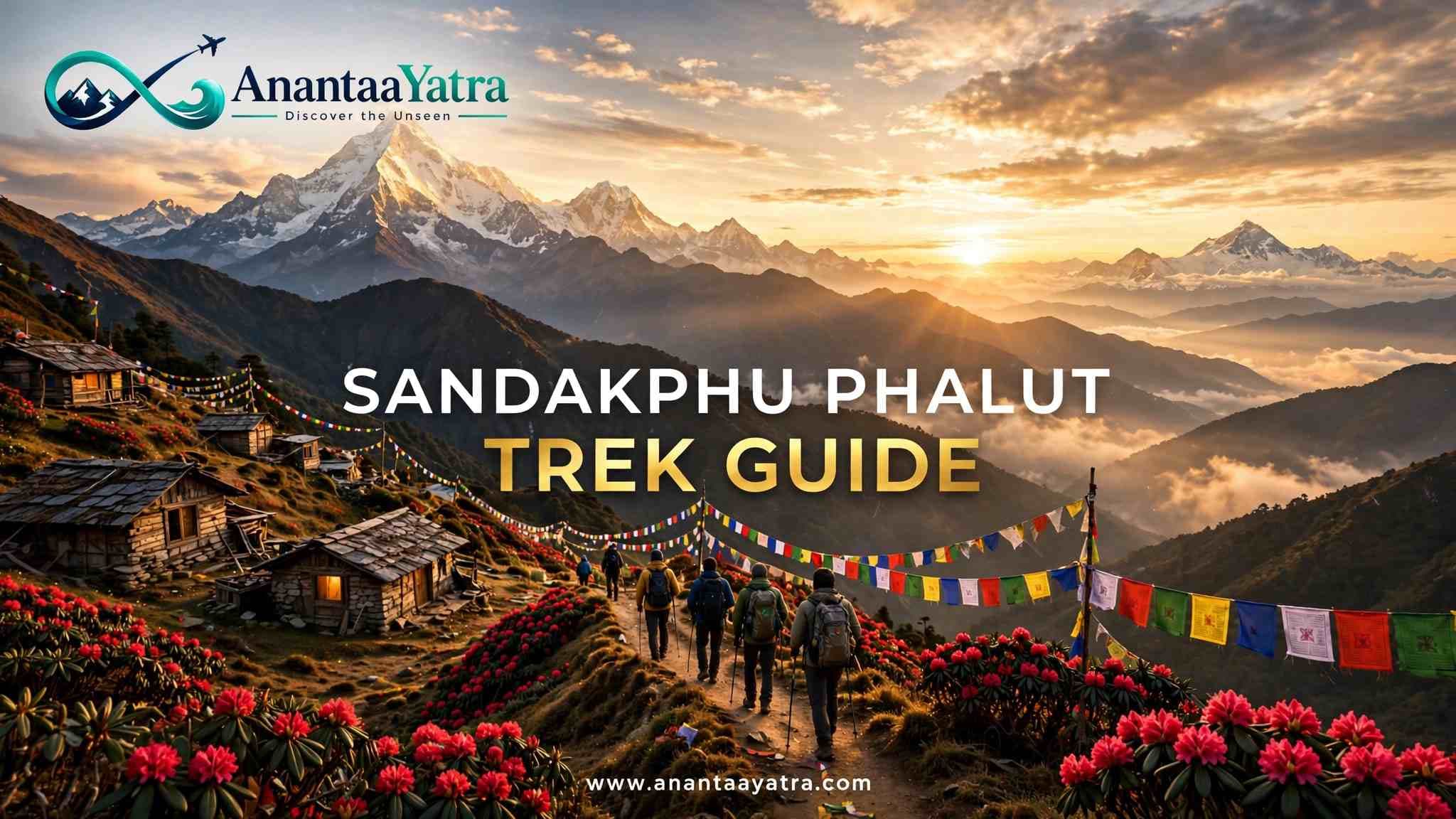
“Plan the Sandakphu Phalut trek with 2026 permit guidance, Land Rover booking costs, guide charges, route options, accommodation tips and a complete gear checklist.”
Trekking guide · Updated 12 October 2026
Sandakphu Phalut Trek Guide: Land Rover Bookings, Guide Charges, Permits and Gear Checklist
The Sandakphu–Phalut trail is one of North Bengal's memorable Himalayan journeys. It follows a high ridge through villages, forests and open mountain landscapes, with the possibility of seeing the Kanchenjunga range and other major Himalayan peaks on a clear day. But before you pack your boots, you need to understand the route, current entry rules, guide arrangements, overnight stops and the difference between trekking and travelling by a rugged local vehicle.
This practical guide explains how to plan the trek, arrange transport from Manebhanjan, estimate costs, prepare the right gear and make sensible decisions when mountain weather changes.
At a glance: Sandakphu–Phalut costs
The following figures are planning references based on recent reporting and published local rate information. They are not guaranteed quotations. Confirm the applicable rate, route availability and permit rules before making a payment.
Forest entry: Indian visitors
₹200 per person
Reported in September 2026. Confirm whether the applicable charge is per entry, per day or otherwise under the current rules.
Forest entry: foreign visitors
₹500 per person
Recent reported fee. International visitors should verify identification and entry requirements before travel.
Vehicle entry fee
₹480 reported
Confirm the current fee, the vehicle category and whether it is already included in your booking quote.
Guide charge
₹1,200 per day reported
Recent reporting describes this fee where required. Ask the local forest authority or recognised operator about the rules for your exact itinerary.
1. Know before you go: what makes this trek special?
Sandakphu stands at approximately 3,636 metres (11,929 feet), while Phalut is around 3,600 metres (about 11,811 feet). Both are on the Singalila Ridge in Darjeeling district, close to the India–Nepal border. The ridge is known for expansive views of the Himalayan skyline, including the Kanchenjunga group and, when visibility permits, the Everest group.
The journey is not simply a walk to a viewpoint. The longer route gives you time to experience mountain settlements, changing vegetation, quiet forest sections and the exposed ridge landscape. Spring brings rhododendron blooms, while autumn often offers clearer skies. Winter can bring severe cold and snow, and the monsoon can bring rain, slippery paths, poor visibility and landslide-related disruption.
The route is commonly planned over several days, with overnight stops around places such as Tumling, Kalipokhri, Sandakphu and Phalut. The precise plan depends on fitness, accommodation availability, weather, guide arrangements and whether you intend to finish at the same trailhead or descend towards another village.
2. Trekking versus a Land Rover-style mountain trip
Many travellers use the term “Land Rover trip” for the rugged vehicle journey from Manebhanjan towards Sandakphu. The historic Land Rover name remains closely associated with the route, but the actual vehicle available may be a locally authorised 4×4 or another association-operated vehicle. Confirm the vehicle model and service directly when booking.
| Factor | Multi-day trek | Mountain vehicle trip |
|---|---|---|
| Best for | Walkers who want the trail, villages and gradual journey through the ridge. | Travellers with limited time, mobility constraints or a preference for vehicle access. |
| Typical duration | About 4–6 days for a Sandakphu–Phalut route, depending on the start and finish points. | Can be a long day for Sandakphu alone; Phalut generally requires more time and a higher budget. |
| Physical effort | High: sustained walking, climbs, descents and carrying a daypack. | Lower walking demand, but the road is rough and the ride can be uncomfortable. |
| Guide planning | Confirm current forest rules and arrange a recognised guide where required. | Confirm vehicle authorisation, driver arrangements and whether any guide or entry fee applies. |
| Main cost drivers | Guide, porter, accommodation, meals, permits and transfers. | Vehicle fare, overnight halts, entry charges, meals and accommodation. |
| Experience | More time on foot and a closer connection with the trail. | More distance covered by road, with less time walking between settlements. |
| Important limitation | Weather, fitness, trail conditions and daylight determine daily progress. | The rugged route may be slow, bumpy and subject to vehicle or road restrictions. |
A vehicle trip is not automatically an easier or safer choice in every condition. The road can be rough, exposed and affected by weather. Equally, a trek should not be treated as a casual walk simply because accommodation exists along parts of the route.
3. Sandakphu–Phalut route and itinerary options
Manebhanjan is the usual base for the classic approach to Sandakphu. Travellers commonly reach it from Darjeeling, Siliguri or the New Jalpaiguri (NJP) railhead. The trail then climbs through settlements and forested stretches before reaching Sandakphu. Phalut lies farther along the ridge.
Example 6-day trek plan
| Day | Route idea | Planning notes |
|---|---|---|
| Day 1 | Arrive in Manebhanjan | Check in, meet your guide or operator, confirm permits and review the weather. Staying overnight avoids a rushed start. |
| Day 2 | Manebhanjan to Tumling or Tonglu area | A climbing day. Keep your pace steady and allow time for rest and hydration. |
| Day 3 | Continue via Gairibas and Kalipokhri towards Sandakphu | Trail conditions and the chosen overnight stop may change the distance covered. |
| Day 4 | Sandakphu to Phalut | A long ridge section. Confirm accommodation, water availability, weather and the day's walking plan in advance. |
| Day 5 | Begin descent towards Gorkhey, Samanden or another agreed stop | The descent and route choice require planning; do not improvise a remote route in poor visibility. |
| Day 6 | Continue towards the agreed exit point, such as Rimbik, and transfer onward | Pre-arrange your pickup and leave a time buffer for mountain-road delays. |
Some itineraries start from a different point, retrace the route, or take a different descent. Ask your guide to provide a day-by-day plan with overnight villages, estimated walking time, elevation changes, meal arrangements and emergency exit options.
Should you include Phalut?
Add Phalut if you have enough days, are comfortable with sustained walking and want to experience more of the ridge beyond Sandakphu. If your schedule is short or your group includes inexperienced walkers, a shorter Sandakphu itinerary may be the more sensible choice.
4. Land Rover bookings: how to arrange the vehicle
Manebhanjan is the key place to arrange a local vehicle for the Sandakphu route. Because fares, availability and vehicle rules can change, contact the recognised local association or an established accommodation provider before travelling. Do not assume that a third-party online package includes every required fee.
Booking checklist
- Confirm the route: Ask whether the quote covers Tumling, Sandakphu or Phalut, and whether it is one-way or return.
- Ask about the actual vehicle: Confirm the vehicle type, passenger capacity, luggage allowance and whether the operator is authorised for the route.
- Clarify night halts: Ask whether the fare includes a halt, and how much each additional night costs.
- Separate the fees: Get the vehicle fare, forest entry, vehicle entry, guide charge, accommodation and meals listed separately.
- Confirm cancellation terms: Mountain weather or restrictions may disrupt travel. Ask what happens if the route is closed or a vehicle cannot proceed.
- Keep written confirmation: Save the booking details and the operator's contact number offline.
5. Permits, forest entry fees and guide charges
Sandakphu and Phalut are within the Singalila National Park region. Entry rules and charges are set by the relevant authorities and may change. The figures below reflect recent reporting published in September 2026; they should be reconfirmed for your date of travel.
| Item | Recent reported amount | What to confirm |
|---|---|---|
| Indian visitor entry fee | ₹200 per person | Current charging basis, validity and whether the fee applies to each day or entry. |
| Foreign visitor entry fee | ₹500 per person | Current rate, accepted identification and any additional requirements. |
| Vehicle entry fee | ₹480 reported | Vehicle category and whether the operator has already included it in the quote. |
| Guide charge | ₹1,200 per day where required | Whether a guide is mandatory for your specific trek, group and route, and what the fee covers. |
| Other charges | May vary | Any porter, camera, accommodation, local access or administrative charge that applies to your itinerary. |
Pay fees only through the method currently specified by the responsible authority or authorised operator. Request a receipt and keep it with your travel documents. If a fee is described differently by a hotel, driver and online guide, check with the forest office before paying twice.
Where to verify official information
- West Bengal Tourism: Sandakphu destination information
- Darjeeling district administration: trekking routes and adventure information
- Darjeeling district: list of trained and certified tourist guides
Official destination pages are useful for route context and contacts, but they may not display every newly revised fee. Confirm charges directly before travel.
6. Cost comparison: trek, Sandakphu vehicle trip and Phalut vehicle trip
The total cost depends on group size, route, number of nights, accommodation standard, guide arrangements, food, transfers and current entry fees. A vehicle fare is usually a vehicle-level expense, while entry fees and many trekking services are charged per person or per day.
| Cost item | Trek | Vehicle to Sandakphu | Vehicle towards Phalut |
|---|---|---|---|
| Transport / vehicle | Transfers to the trailhead, plus return transfer from the exit point | ₹5,500 reported for same-day return | Recent published association-style charts vary; one current travel guide lists around ₹9,000 for a Phalut return trip. Confirm directly. |
| Additional night halt | Accommodation charged per person or room, depending on the lodge | ₹1,500 per extra night reported for the vehicle | Confirm vehicle halt fees and the accommodation cost separately. |
| Forest entry | Budget the current fee per traveller under the applicable rules | Budget the visitor fee and any applicable vehicle fee | Confirm how entry fees apply to the longer itinerary. |
| Guide | Recent reporting quotes ₹1,200 per day where required | Ask whether a guide is required or included in the vehicle package | Ask whether a guide is required or included for the complete route. |
| Accommodation and meals | Budget for each overnight stop and all meals | Separate from the vehicle fare unless stated otherwise | Separate from the vehicle fare unless stated otherwise. |
| Best cost-control method | Share guide/porter costs where permitted and book stays in advance | Share the vehicle with a compatible group if the operator allows it | Ask for an itemised quote that covers the exact itinerary and halts. |
The vehicle prices above are recent published references, not guaranteed tariffs. Some online sources list different prices because they were updated at different times or describe different routes and services. Confirm the current rate with the local association before treating a figure as final.
Build your own budget
For a realistic trip budget, add these items rather than comparing vehicle prices alone:
- Travel from NJP, Bagdogra, Siliguri or Darjeeling to Manebhanjan.
- Return transfer from the trek's actual finishing point.
- Guide and porter charges, where applicable.
- Forest and vehicle entry fees.
- Accommodation for each night and all meals.
- Warm clothing or gear rental if you do not own suitable equipment.
- Emergency contingency for an extra night, weather delay or transport change.
7. Accommodation, meals and water on the trail
The route has a mix of trekkers' huts, basic lodges, homestays and private accommodation, but facilities are not the same at every stop. Availability can be limited during popular seasons, holidays and clear-weather windows.
Book overnight stops early
Decide the overnight villages before setting off and confirm your bookings directly with the property or your trekking operator. Ask whether bedding, blankets, hot water, meals, drinking water and charging points are available. Do not assume every lodge offers the same facilities or that an online listing is current.
Food and drinking water
Simple hot meals are commonly available at established stops, but menus can be limited and supply depends on weather and local logistics. Carry energy-dense snacks for the day, and bring a reusable water bottle with a reliable purification method suitable for the trip. Do not assume every stream or spring is safe to drink untreated.
What to ask before paying
- Is the reservation confirmed for the correct date and number of people?
- Are meals included, and what happens if the group arrives late?
- Are blankets supplied, or is a sleeping bag required?
- Is there a reliable source of treated drinking water?
- What is the cancellation policy if weather or route restrictions change the plan?
8. Complete Sandakphu–Phalut trekking gear checklist
Pack for cold, wind, rain and changing conditions, even if the weather feels pleasant at the trailhead. The ridge is exposed in places, and temperatures can fall quickly after sunset.
Clothing
- Moisture-wicking base layers.
- Warm mid-layer such as fleece or wool.
- Insulated jacket appropriate for the season.
- Waterproof and wind-resistant outer shell.
- Comfortable trekking trousers and a spare dry layer.
- Warm hat, gloves, neck warmer and several pairs of socks.
- Lightweight sleepwear and dry clothing for the evening.
Footwear and pack
- Broken-in trekking boots with suitable grip and ankle support.
- Spare laces and blister-care supplies.
- Daypack with a comfortable hip belt.
- Rain cover or waterproof pack liner.
- Trekking poles if you are comfortable using them.
- Dry bags or sealed pouches for electronics and spare clothes.
Navigation, power and documents
- Valid photo identification and any required permit or booking confirmation.
- Offline maps and the guide/operator's contact details.
- Phone, charging cable and a power bank kept warm and dry.
- Headlamp with spare batteries.
- Cash in small denominations for local expenses where digital payments may be unreliable.
Health and emergency essentials
- Personal medicines and any medication prescribed by your clinician.
- Basic first-aid supplies, blister dressings and antiseptic wipes.
- Sunscreen, lip balm and sunglasses with suitable UV protection.
- Water bottle and a reliable water-treatment method.
- High-energy snacks and electrolyte supplies appropriate for you.
- Emergency contact details and any personal medical information a guide needs to know.
Optional equipment
- Sleeping bag suited to the forecast and accommodation conditions.
- Binoculars for wildlife and distant mountain views.
- Camera, spare battery and protective pouch.
- Lightweight gaiters or traction aids when conditions justify them and a qualified guide recommends them.
9. Best time to trek and how to plan around weather
| Season | What you may experience | Planning advice |
|---|---|---|
| April–May | Rhododendron blooms and spring colour; showers can still occur. | Carry waterproof layers and reserve accommodation early. |
| June–September | Monsoon rain, slippery trail conditions, low visibility and possible landslide disruption. | Check official advisories carefully; avoid treating this as a guaranteed safe trekking window. |
| October–November | Often favoured for clearer views and cooler weather, though conditions vary year to year. | Book early for popular dates and carry warm layers for cold nights. |
| December–March | Very cold conditions and possible snow or ice; access can be affected by weather. | Go with suitable equipment and experienced local support; confirm current trail and vehicle access. |
No season guarantees clear skies or safe trail conditions. Before departure, check the local forecast, ask your accommodation or guide about the latest conditions, and be willing to postpone or shorten the route if conditions deteriorate.
10. Safety, altitude and responsible trekking
The trek reaches elevations above 3,500 metres. Even fit travellers can experience altitude-related symptoms, cold stress, dehydration or exhaustion. A gradual pace and sensible itinerary are safer than trying to cover too much distance in one day.
- Acclimatise sensibly: Avoid rushing from the plains into a demanding high-altitude itinerary without time to rest.
- Recognise warning signs: Headache, nausea, unusual fatigue or dizziness can be signs of altitude illness. Tell your guide promptly if symptoms appear.
- Do not ascend with worsening symptoms: Seek professional medical advice and follow the guide's emergency plan. Severe symptoms require urgent help and descent where appropriate.
- Respect the weather: Turn back or change the plan if visibility, wind, snow, rain or trail conditions make progress unsafe.
- Stay with your group: Avoid taking unfamiliar shortcuts or leaving the route without the guide's knowledge.
- Protect the environment: Carry waste back, avoid disturbing wildlife and follow all park rules.
- Check wildlife guidance: Singalila is important habitat for rare wildlife. Keep a respectful distance and never feed or approach animals.
Travellers with medical conditions or concerns about altitude should speak with a qualified healthcare professional before booking. A travel blog cannot determine whether a particular trek is medically appropriate for an individual.
11. More travel guides from Anantaayatra
Explore these related guides as you plan your North Bengal trip. The first two URLs are established Anantaayatra pages; replace the remaining placeholder URLs with the final URLs of relevant published articles before launch.
- Explore travel guides on Anantaayatra
- Bishnupur Travel Guide: Discover the Terracotta Heritage of West Bengal
- Darjeeling travel guide: places to visit and itinerary
- Dooars travel guide: forests, wildlife and tea gardens
- Best time to visit North Bengal
- Kolkata to North Bengal self-drive road trip
- How to reach Darjeeling from NJP and Bagdogra
- North Bengal homestays: choosing your base
- Himalayan packing checklist for first-time trekkers
- North Bengal travel budget: transport, food and accommodation
Frequently asked questions
How many days are needed for the Sandakphu–Phalut trek?
A common planning window is around 4–6 days, depending on your starting point, walking pace, overnight stops and exit route. Confirm the daily plan with your guide before booking.
How much is the Sandakphu forest entry fee in 2026?
September 2026 reporting listed ₹200 per Indian visitor and ₹500 per foreign visitor, along with a ₹480 vehicle entry fee. Confirm the applicable fee and charging basis with the forest authority before travel.
How much does a Sandakphu Land Rover trip cost?
A September 2026 report quoted ₹5,500 for a same-day return vehicle trip to Sandakphu, with an additional ₹1,500 per extra night halt. Rates may change, and Phalut costs more. Confirm the exact fare with the local association.
Is a guide required for the Sandakphu–Phalut trek?
Guide requirements can depend on current forest rules, the route and the type of visit. Recent reporting refers to a ₹1,200 daily guide charge where required. Confirm the rule for your exact itinerary with the responsible authority before departure.
Can I visit Sandakphu without trekking?
Vehicle trips are available on the mountain route, subject to current vehicle rules, road conditions and access restrictions. Contact the local association to confirm which authorised vehicle and route options are operating.
What is the best month for the Sandakphu–Phalut trek?
April–May is known for spring flowers, while October–November is often favoured for clearer mountain views. Weather varies every year, so check the current forecast and trail conditions before setting out.
What should I pack for Sandakphu and Phalut?
Carry broken-in trekking boots, warm layers, a waterproof outer shell, gloves, a hat, a headlamp, a water bottle, a reliable water-treatment method, a first-aid kit, personal medicines, identification and offline route information.
Is Sandakphu suitable for first-time trekkers?
Some beginners complete the route with preparation and suitable support, but the altitude, weather and daily walking demands should not be underestimated. Choose an itinerary that matches your fitness and consult a qualified professional if you have health concerns.
Can I trek Sandakphu–Phalut during the monsoon?
Monsoon conditions can bring heavy rain, slippery trails, poor visibility and landslide disruption. Check official advisories and local guidance, and be prepared to postpone if conditions are unsafe.
Final thoughts: prepare well, travel responsibly
The Sandakphu–Phalut journey rewards travellers who give it enough time. Decide whether you want to walk the ridge or travel by an authorised mountain vehicle, reserve the right overnight stops, and confirm guide requirements, entry fees and transport fares before leaving home.
A well-planned trek is not about carrying the most gear or completing the route at any cost. It is about being ready for cold weather, respecting the mountain environment, listening to local advice and leaving room in the itinerary for conditions to change.